
I was at a local garden club meeting last Monday evening where Karen Legros was the guest speaker, talking about and demonstrating Ikebana. She’s studied it for more than 20 years and is an executive of the Toronto chapter of the Ohara (no apostrophe) School of Ikebana, which was founded in Japan in 1895. From their site:
Unshin Ohara founded Ohara School in the late nineteenth century, when Japan opened itself to the influence of Western culture. His departure from previous ikebana lay in the creation of a new form which he called the moribana style. This style later evolved into the school’s “landscape arrangement”. He also designed and produced the wide, shallow containers most suitable for works in the moribana style.
The Ohara school “…emphasizes seasonal qualities, natural growth processes, and the beauty of natural environments.”
One of the Carol’s demonstrations was the ‘Rising Form’ arrangement, possibly the most used or recognized form of ikebana. Guidelines are to have three elements:
- A subject, or main thing, which should be less than twice the diameter of the container plus its height (ie a 20 cm wide, five cm high dish should have, as its main subject, something no higher than 45 cms). This subject can be straight, or set at an angle up to 20 degrees in any direction.
- An object, which is less than 1/3 the height of the subject, slanted forward at about 45 degrees.
- A filler to complete the arrangement, the tip of which can overhang the lip of the container.
In other words, similar to when designing any container for your garden, think thrill, fill and spill, but with specific dimensions. Also, think less is more. The idea here is NOT to have a full, lush vase but rather a more contemplative, sparse, thought provoking arrangement.
I learned at this talk that my little ikebana vessel is woefully inadequate for most arrangements, and my teeny tiny kenzan, the small round ‘frog’ with pointy tips to hold stems in place, is not nearly heavy enough for the task at hand. Another thing I learned was to make the final cut of the stem under water, ie in a bowl of water, so that the first thing drawn into the flower stem is water, not air, helping, Carol said, the bloom to last longer than if cut in the open air.
Still. Here I am, Monday morning, the skies starting to drip, mosquitoes dive-bombing, tape measure in hand, trying to do a ‘proper’ ikebana arrangement…
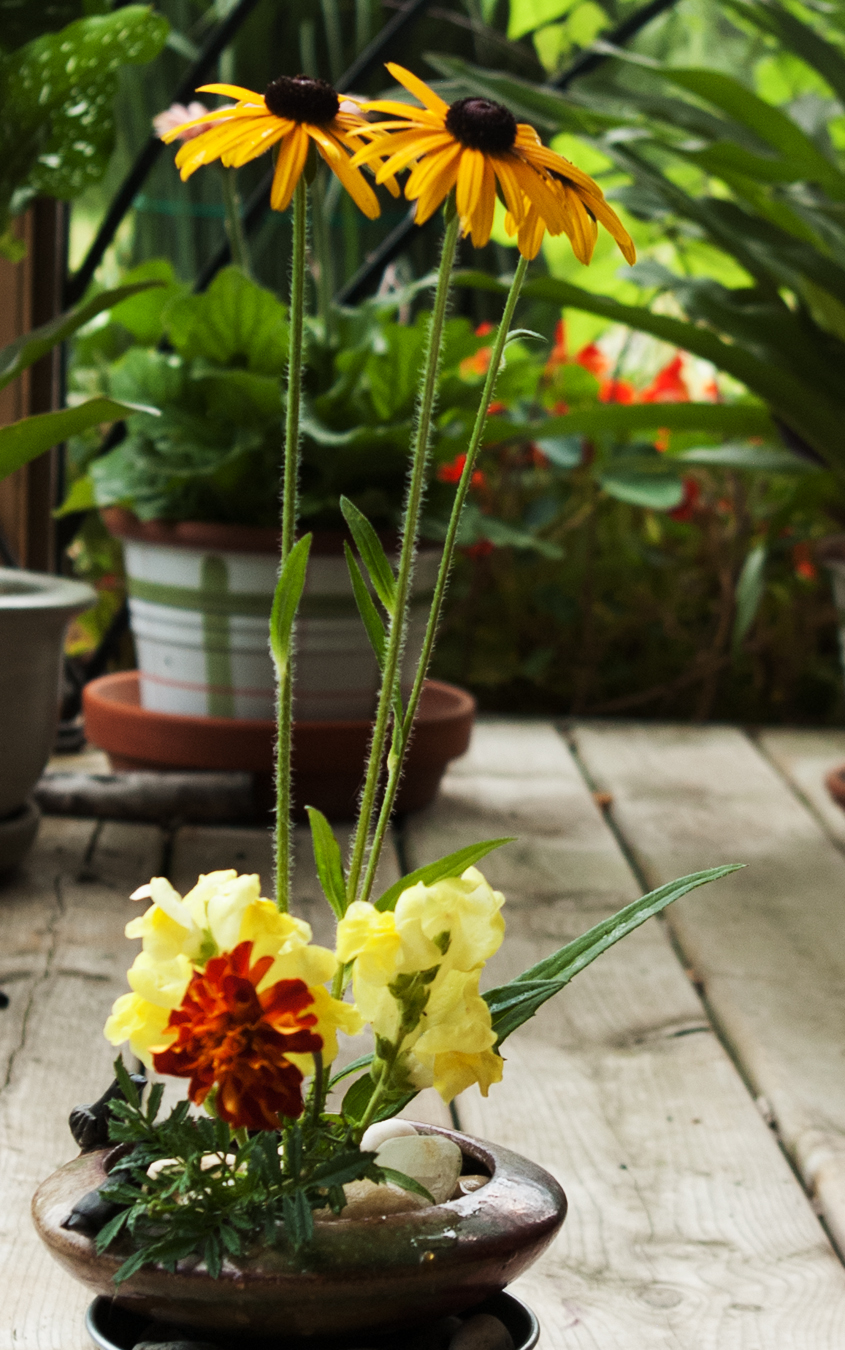
In the end, I don’t think it looks quite right – the object, the snapdragons, just don’t seem tall enough even though I cut them to four inches. I should have played around with the angles more, I think, to provide more interest, but I do like the colour combination here – orange, yellow, orange. I also like the Tagetes spilling over the edge, and the three Rudbeckia fulgida look great standing 12 inches tall, contemplating the world. Note that there doesn’t have to be a lone stem as the subject or object although that’s what you will often see.
Also in the end, after I brought this arrangement to the kitchen windowsill, I saw a little movement in the Antirrhinum… that particular stem was quickly shown the door.

Thanks to Cathy at Rambling in the Garden who hosts the weekly garden meme In A Vase On Monday, featuring flowers from our gardens. Click the link to join or see what others are sharing today. Have a lovely August week everyone!
 County Gardening
Interesting, Chris. And I do like the end result.
LikeLiked by 1 person
Thanks Jan!
LikeLike
Ikebana, I think, is very serene, but very structured. It goes against my ‘let the flowers be wild’ nature. I have a more: I-like-it-like-this’ nature.
LikeLiked by 1 person
VERY structured…but when successful, I think, can also accentuate the wildness in nature.
LikeLike
I love Ikebana and you are brave to give it a try. I love it. And how you will keep learning.
LikeLiked by 1 person
You’re right…gardening is continual learning, and the demonstrator said she was always learning more about ikebana, even after 20 years
LikeLiked by 1 person
I think of Ikebana as a meditative style. “Enter Zen from here.” 🙂
A good practice to slow the mind!
LikeLiked by 1 person
Gosh, that is very structured style, Chris, and I wonder how many you would have to do before you remembered the size and angle of each eleemnt without having to look at your instructions? To me, ‘the subject’ looks too tall – but what do you think? Perhaps if the snapdragons were taller, as you wondered, it would alter the realtive proportions. It will have been a very interesting exercise for you as creator and us as observers – will there be Ikebana Try #2. 3, 4 etc?
LikeLiked by 1 person
It was interesting to hear a bit about the history of this practice and yes, there may well be further attempts! Just need a larger kenzan and container, I think.
LikeLike
I accidentally found a good plastic kenzan (frog!) on Amazon, with suction pads on the bottom – I followed a link for Japanese sellers I think. I am hoping they come in a range of sizes – this one was about 3″ which is certainly bigger than the metal ones I have
LikeLike
That’s a very precise, almost scientific approach to floral arrangement. Kudos to you for trying it out! Did the guest speaker share her own examples? Did you like them? I twitch a little when it comes to guidelines for what I like to think is more art than science.
https://krispgarden.blogspot.com/
LikeLike
Ikebana was one of only three types of floral design that we cursorily studied in school. It was the most rudimentary of floral design classes for flower growers, so that we would be a bit more familiar with the qualities that were important in our products. We studied European mass design in a bit more detail, even though that type of design does not involve much detail, and certainly not as much as Ikebana. Western line design was the most prominent and popular type of floral design at that time in the late 1980s, so was most of what we learned about.
LikeLike
A very nice arrangement to stand back and admire. 😃 The info about ikebana was interesting Chris. I am sure I have read something about the ‘rules’ before and that is partly why I have never tried it – I find it so hard to stick to recipes, crochet patterns, etc that I would probably not succeed! So well done for giving it a go and I do hope you will make more ikebana arrangements to inspire me to give it a go!
LikeLiked by 1 person
Thanks Cathy – it’s fun to go outside your comfort zone now and then eh?
LikeLiked by 1 person