Colonies of Canada Mayapple – Podophyllum peltatum – can be found in the woods across the eastern part of North America, from Ontario and Quebec down to north Texas. They spread both by seed and by underground rhizomes, and I’m lucky enough to have a few small colonies on my property. The low, wide leaves totally cover an area but die back mid summer; right now a colony under the treeline by the driveway looks like this:

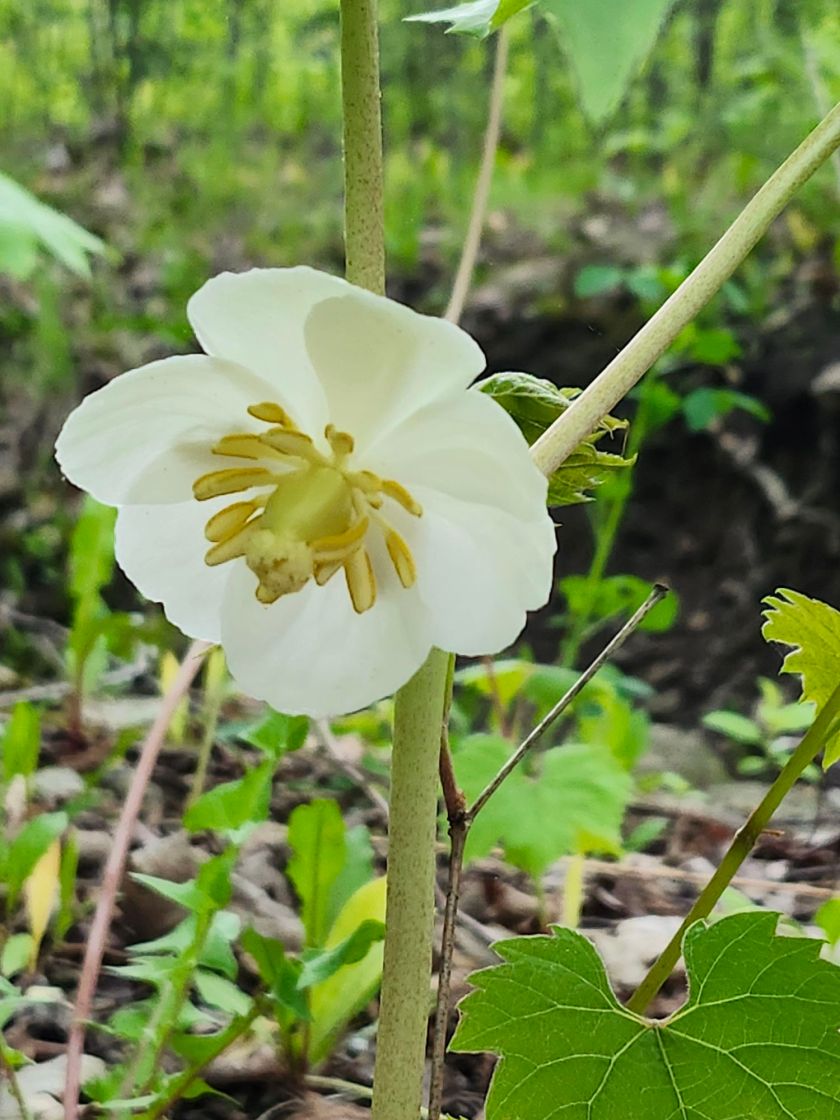
Although some sources say the flower is ‘showy,’ you’d be hard pressed to find one unless you got down on your hands and knees, or if you happened on one plant standing apart from the crowd, perhaps one which started from a seed left by a squirrel. Apparently squirrels consider Mayapple fruit a delicacy: people can eat them as well, as long as they’re fully ripe.
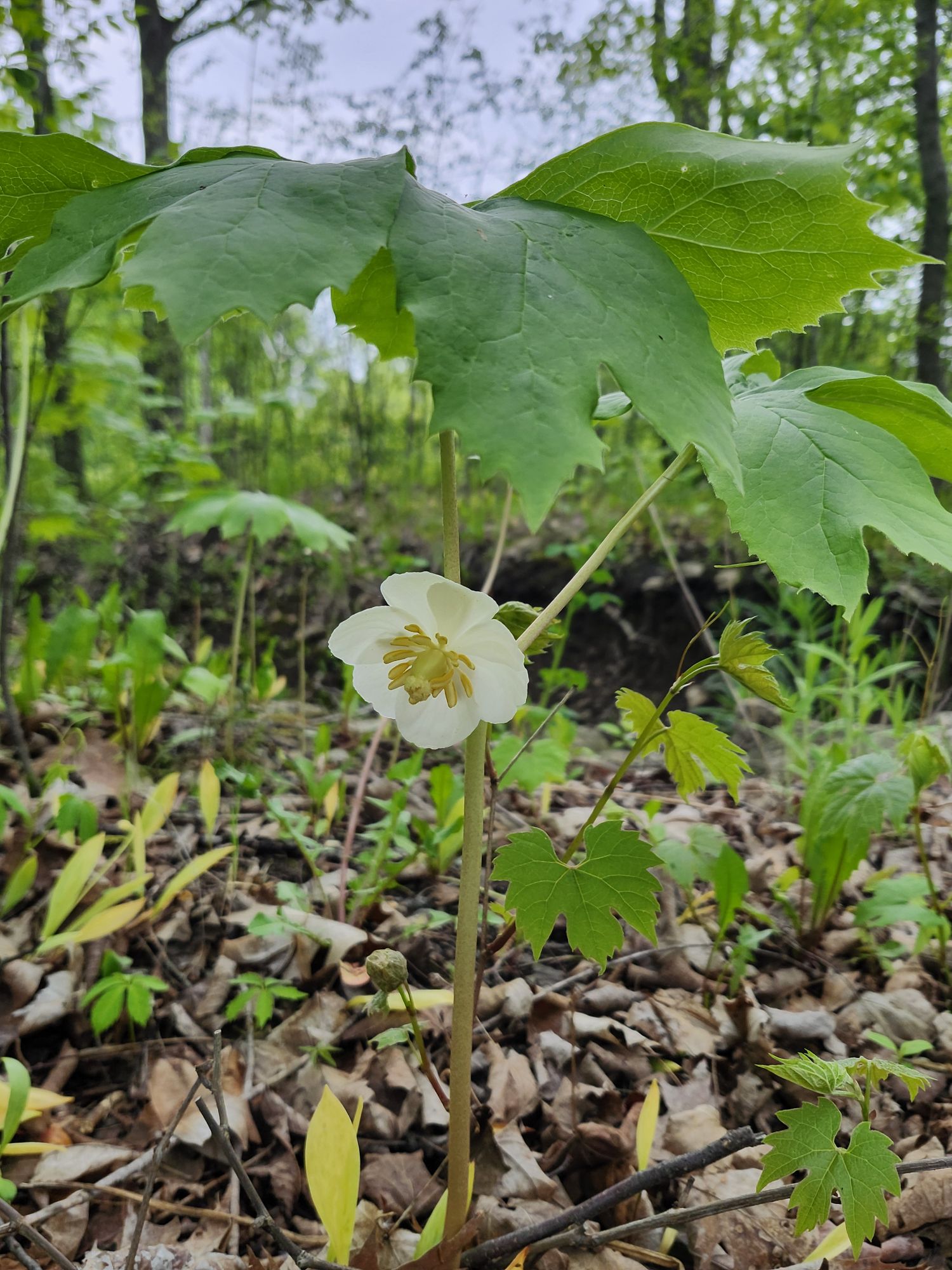
Like many spring ephemerals the Mayapple doesn’t mind our dry summers (because they’re dormant for most of it anyway) or the heavy clay soil (possibly because they grow under trees which means decades of leaf humus has naturally amended the soil).

 County Gardening
This is another I don’t remember seeing. Despite the hidden flowers, those attractive, umbrella-like leaves certainly are noticeable.
When I looked at the USDA map, your comment about your soil became more interesting. If you scroll to enlarge the map until county names appear, you’ll notice Hardin and Tyler down in the southeast corner of the state. Those are the two counties I spend time in when I go to east Texas, and the mayapple isn’t listed for them. What intrigued me is that both of those counties tend to have sandy soils, while the surrounding counties in green, where the plant can be found, are known for their heavy clay soils. How about that?
LikeLiked by 1 person
I know now why that field of may apples looked familiar. Today I came across a good-sized patch of jack-in-the-pulpil, and their leaves rise up above the flowers and fruit in the same way. They have a different number of leaflets, but the effect is the same.
LikeLiked by 1 person
I LOVE jack-in-the-pulpit! AND I spotted the first ones in my garden a few weeks ago – never before had them here as far as I know. How did the seeds arrive, I wonder….
LikeLiked by 1 person
That is interesting! Here in Prince Edward County, which is about 400 square miles in area, we have a mix of very sandy soil, nice loamy soil and, in the northwestern part where I live, very heavy stony soil, described as ‘clay gravel’ for the numerous limestone chunks to be found near the surface. Not fun for a gardener!
LikeLiked by 1 person
Interesting, Chris. I learn a lot from your blog.
Sent from my Galaxy
LikeLiked by 1 person
Thanks Jan – I’m constantly learning, often from the comments on my blog!
LikeLike
The plant to be careful of! It’s deadly toxic! Even the seeds of the ripe fruit, which Box turtles love…but how do they spit out the seeds?
LikeLiked by 1 person
So many plants are not great for human (or pet) consumption….
LikeLike
A plant to be careful of…it’s deadly toxic…even the seeds in the ripe fruit, which is a favored food source of Box turtles & is one way the plant is spread. I wonder how they turtles tolerate the toxin?
LikeLike
I have a very aggressive patch on the wood edge, best place for it, I’d say. A cool plant, esp. when it emerges in spring with its hunched shoulders, opening like an umbrella. 🙂
LikeLiked by 1 person
It’s very cool; being able to see the flower is a bonus. It’s almost, in that way, like a native Hellebore…
LikeLiked by 1 person
Agreed, it does look like one, and equally toxic, I’ve read.
LikeLiked by 1 person