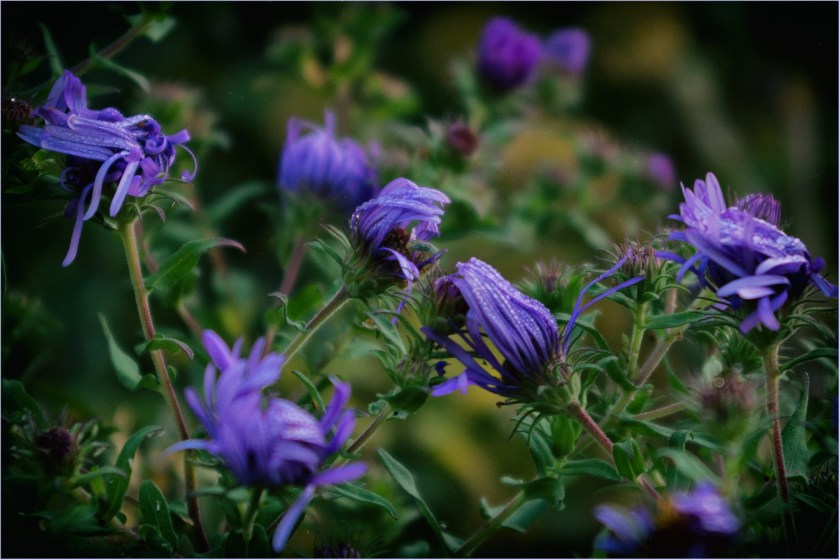
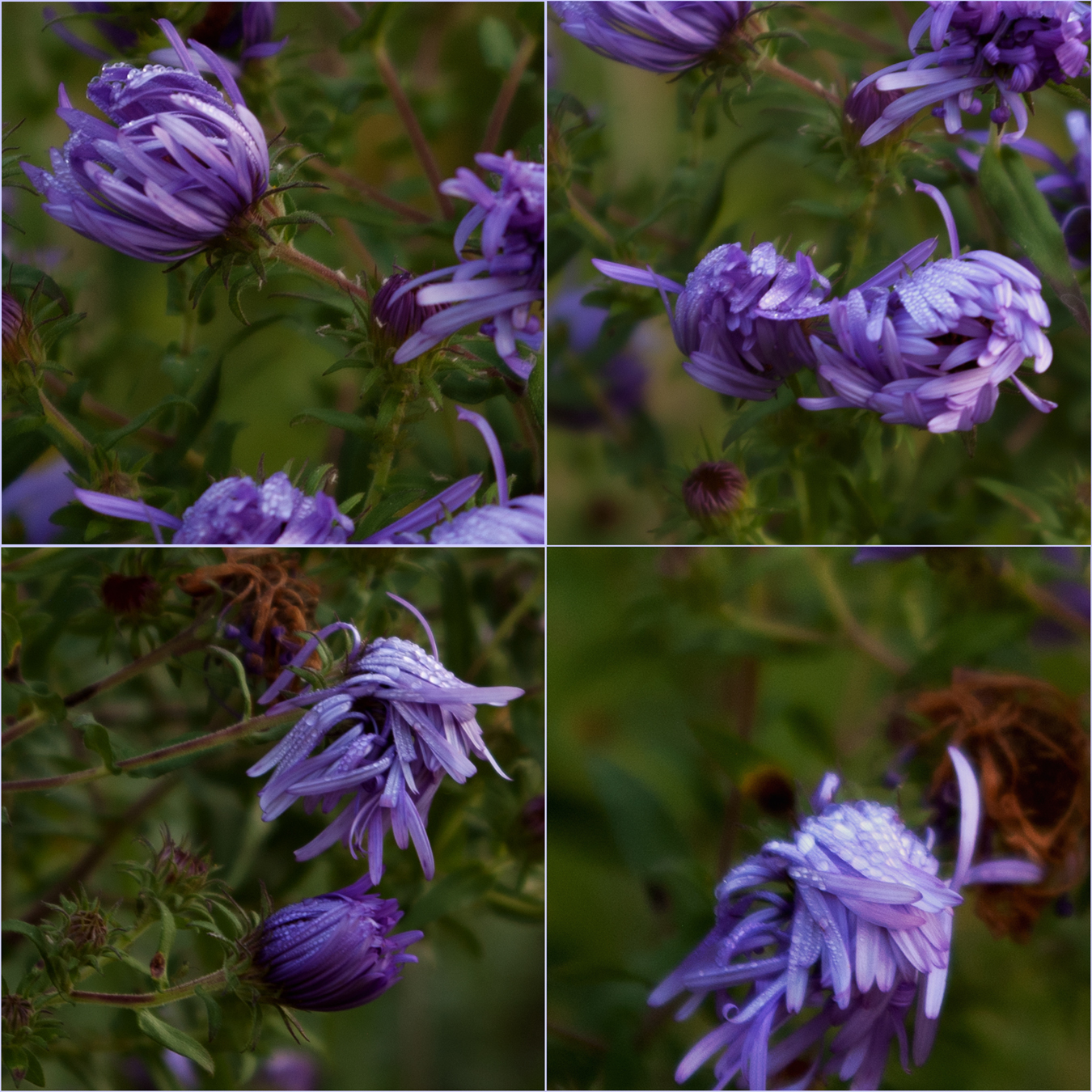
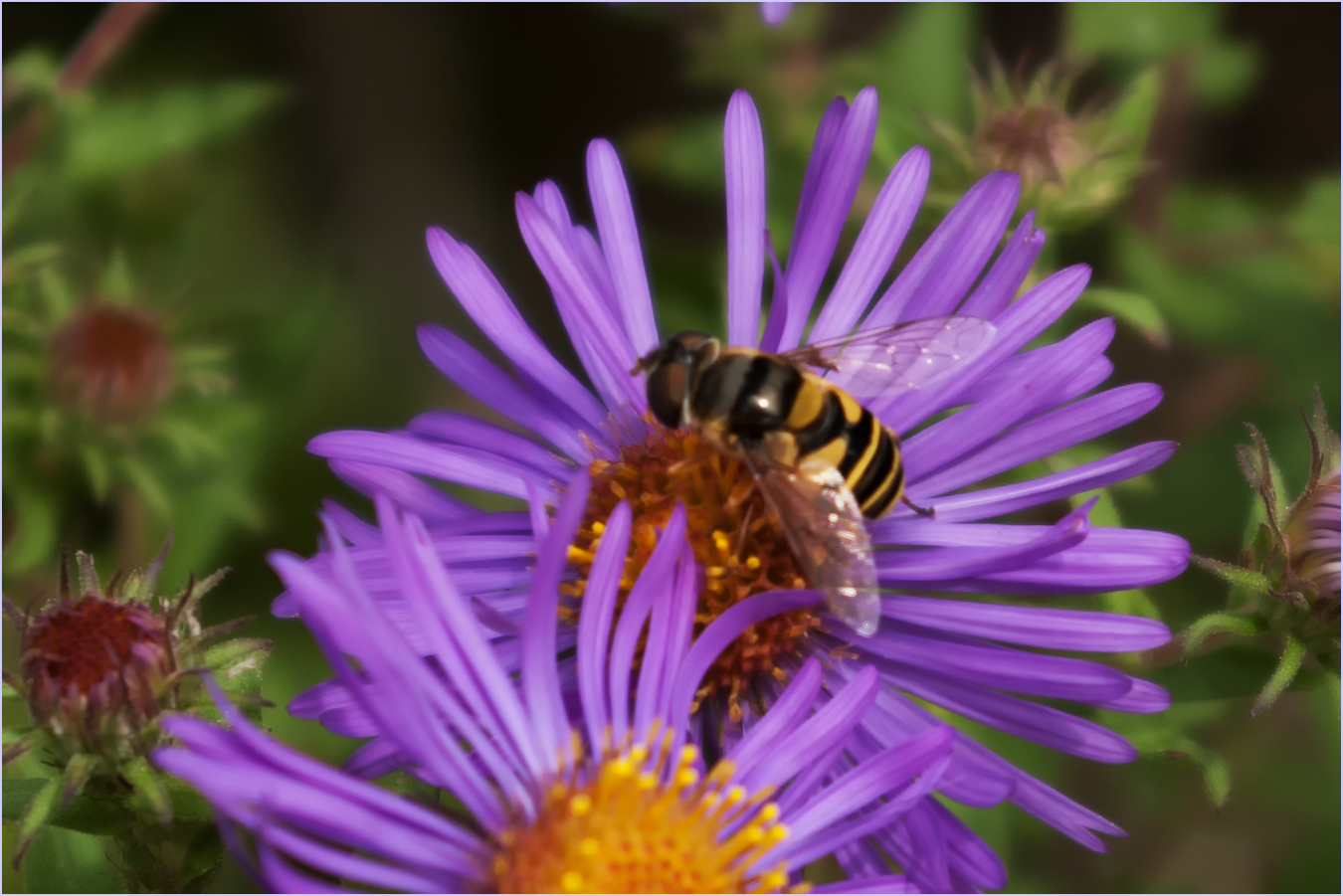
We have one or two larger, purple asters, but not this one. It’s a lovely thing — and a reminder that autumn really is coming. You may know that a variety of them are known as Michaelmas daisies, since they tend to appear around the time of the Michaelmas feast: a celebration of St. Michael the Archangel. That hoverfly is celebrating early!
Well….as your posts and comments on my posts often do, this had me thinking, even though it’s quite early on a Sunday morning! I have of course heard of Michaelmas daisies, and I know that what we in North America have, since the dawn of time, called this (and about 400 others) an Aster, but it’s now in the new, much harder to spell, genus. This morning I learned that the split happened in 1994; around 180 plants are still Asters (all but two native to Europe and Asia) and the North American ones, differentiated by chromosomes and ‘glandular achenes,’ were further split into several different classifications.
Also, fun fact, the name Symphyotrichum was proposed in 1832, the earliest of several nomenclatures to be used to describe the group, which is why we must use it now.
I finally settled down to read the article you attached. It’s very interesting, and also well written, which helps to make a complicated subject understandable. One thing I really liked about it was the division of articles into popular, semi-technical, technical, and molecular. Of course the molecular references are entirely beyond me, but even a couple of the semi-technical were understandable.
I laughed at this:”Asterptarmicoides has proved to be a white-rayed species of Solidago (goldenrod).” The first thing that came to mind was the ptarmigan: the white-feathered bird.
I never can remember who I’ve shared this article with, but every time I get flummoxed again by these taxonomic changes, I re-read it. What’s not to like about an article titled “Why Do Taxonomists Write the Meanest Obituaries”?
 County Gardening
Yummy nectaring. Flower fly is not the only one who is up early! I bought a plant last week, love the color.
LikeLike
Yes, the blue is magnificent!
LikeLike
We have one or two larger, purple asters, but not this one. It’s a lovely thing — and a reminder that autumn really is coming. You may know that a variety of them are known as Michaelmas daisies, since they tend to appear around the time of the Michaelmas feast: a celebration of St. Michael the Archangel. That hoverfly is celebrating early!
LikeLiked by 1 person
Well….as your posts and comments on my posts often do, this had me thinking, even though it’s quite early on a Sunday morning! I have of course heard of Michaelmas daisies, and I know that what we in North America have, since the dawn of time, called this (and about 400 others) an Aster, but it’s now in the new, much harder to spell, genus. This morning I learned that the split happened in 1994; around 180 plants are still Asters (all but two native to Europe and Asia) and the North American ones, differentiated by chromosomes and ‘glandular achenes,’ were further split into several different classifications.
Also, fun fact, the name Symphyotrichum was proposed in 1832, the earliest of several nomenclatures to be used to describe the group, which is why we must use it now.
Phew! More coffee is needed!
LikeLike
I finally settled down to read the article you attached. It’s very interesting, and also well written, which helps to make a complicated subject understandable. One thing I really liked about it was the division of articles into popular, semi-technical, technical, and molecular. Of course the molecular references are entirely beyond me, but even a couple of the semi-technical were understandable.
I laughed at this:”Aster ptarmicoides has proved to be a white-rayed species of Solidago (goldenrod).” The first thing that came to mind was the ptarmigan: the white-feathered bird.
I never can remember who I’ve shared this article with, but every time I get flummoxed again by these taxonomic changes, I re-read it. What’s not to like about an article titled “Why Do Taxonomists Write the Meanest Obituaries”?
LikeLiked by 1 person
😆😆😆
LikeLiked by 1 person
https://www.guynesom.com/NameChangesInAsterWEB.htm … if your inclined…
LikeLike
Lovely Aster (still learning to spell the other name!) and a sure sign of autumn. Mine are also just starting to open.
LikeLiked by 1 person
lovely thought
LikeLiked by 1 person
Stunning photos! Well taken👏👍. Kind regards…Jay😊
LikeLiked by 1 person
Thanks Jay!
LikeLiked by 1 person
You are welcome👍
LikeLike