
I’m happy to report that, for once, the weather forecast was accurate – we received about 3/4 of an inch on rain Saturday night into Sunday morning – almost 20 mm. Enough to give the garden a much needed drink and to almost refill my three large rain barrels. perfect timing, as well, as temperatures are supposed to remain above 30 much of this week.
Even without the rain there’s a wildflower here with such a deep taproot that it’s shown no ill effects from our summer drought. Queen Anne’s Lace, aka wild carrot or Daucus carota, is a European native that can be found in fields and ditches across most of North America. Its flat white flower umbels dance gracefully atop tall slender stems, attracting dozens of different pollinators in search of pollen and nectar, including this ant.

The collection for this vase was inspired by three Allium Cristophii seedheads. They’re huge, almost volleyball sized, and needed a large container. The individual flowers on the flowerhead are carried by stems that become quite stiff when dried, and the whole things acts as a kind of natural floral frog. I was able to use the allium to hold the Queen Anne’s Lace in place. Wanting a bit more interest I just snipped some keeled garlic, Allium carinatum, and the still ripening seedheads of drumstick allium, A. sphaerocephalon. Oh yes, I also pushed in some annual poppy seedheads through as well.
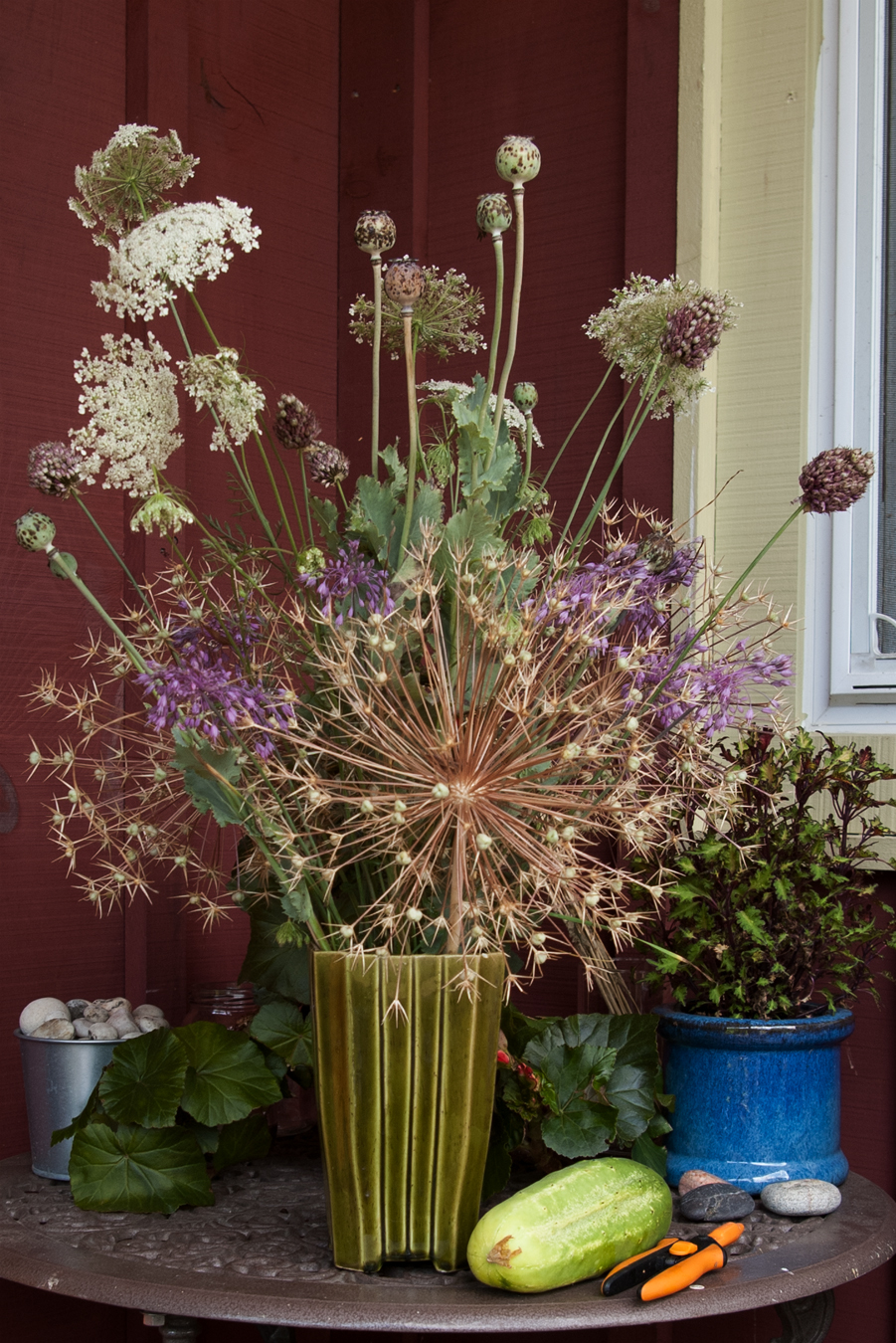
Cathy, who writes Rambling in the Garden and hosts this weekly collection of cut flowers, is always very creative when matching vases with small props. Today, I have the usual – a Begonia getting ready to bloom, a pot of Coleus and some stones – as well as a cucumber just snipped from its vine growing up the trellis at the end of the porch, and the snippers itself. Have a great week everyone!
 County Gardening
The dried Alliums are so striking. I really must grow that variety next year! Love the hints of purple too. And of course, I adore Queen Anne’s Lace and we have simply loads of it in the meadow this year. My theory is that it can not only cope with the dry ground, but it has benefitted from its neighbours not being so drought-proof and has not been crowded out by the grasses this year.
Good news about the rain!
LikeLiked by 1 person
That’s a pretty good theory about the QAL – yes, you really should get some Allium Cristophii – and make sure it has lots of room!
LikeLiked by 1 person
Those Allium christophii heads are very cool, like small fireworks!
LikeLiked by 1 person
Or huge fireworks, if the other alliums are the small ones 🙂
LikeLiked by 1 person
Lovely, Chris. Very artfully written and photographed. Much appreciated in this day and age.
Sent from my Galaxy
LikeLiked by 1 person
Thanks Jan!
LikeLike
That’s a truly interesting arrangement with all the spikey things, roundnesses & seed heads! I like it a lot!
LikeLiked by 1 person
Thanks Alice!
LikeLike
It’s interesting that the Queen Anne’s lace and my Hooker’s eryngo are in the same botanical family; the eryngo also is quite drought tolerant. The size of the Allium seed heads amazed me, as did their ability to serve as faux ‘frogs.’ It’s such a pleasing arrangment; I like the airiness.
LikeLiked by 1 person
Thank you!
So, when I look up something now, I’m immediately met with an AI generated overview of the topic. This was unsettling at first and certainly unasked for – I imagine when I was forced to upgrade to O365 it was foisted on me. So when I typed in ‘Hooker’s eryngo root system’ Mr/Ms AI (I wonder what the preferred pronouns for the AI thingy are…) provided a very detailed description of the fibrous root system (as opposed to the long taproot QAL has) and an explanation about why this makes it suitable for dry situations.
forever learning…
LikeLiked by 1 person
And that made me curious in turn, so I looked a little farther, and found that the eryngo has a combination of fibrous and tap roots. This makes sense to me: “The fibrous roots allow for efficient absorption of water and nutrients from the upper soil layers, which can be beneficial in areas with moderate rainfall or during periods of light moisture. The short taproot [emphasis mine] provides additional stability and potentially allows access to deeper water sources, contributing to its drought tolerance.”
Cool!
LikeLiked by 1 person
Your AI is better than mine!
LikeLiked by 1 person
About the Cucumber: they are such enjoyable plants to grow! Gorgeous, perfect, yellow flowers, lots of Bumbles to pollinate, then the spiky little Cucumbers & lastly crispy Cucumbers to cut off and eat. I grow mine with tomato cages and this year with a Shepherds hook in the pot so they can climb even higher.
LikeLiked by 1 person
Until this year I’ve only grown them sprawled out on the ground. The trellis is so much better! One plant, numerous vines, higher than me!
LikeLike
Allium christophii is one of my first two Alliums, along with Allium schubertii. I know that its floral trusses are big, but was not aware that they get ‘that’ big.
LikeLiked by 1 person
It’s shocking isn’t it? I have 20 or 30 scattered about, and the ones that get more moisture and space are by far the largest and tallest. Many of mine are only about half this size.
LikeLiked by 1 person
That is about as big as mine gets.
LikeLiked by 1 person
What a great idea to use the allium heads to support your other material – a brilliant invention – and I like the motley collection being held in them, as well as your here-and-now props. Thanks Chris! 😀
LikeLiked by 1 person
Thanks Cathy!
LikeLiked by 1 person
Pretty snippy!! I like the orb inspired vase. Yay for rain. Now we need some. I’m still contemplating a volleyball sized allium..
LikeLiked by 1 person
Will they grow in south Florida? I can picture them, adding another dimension of (for me) alienness in your garden, alongside all the tropicals, amidst a cacophony of brilliantly plumaged birds hopping and flying hither and yon.
LikeLike
The Allium seedheads look fantastic!
https://krispgarden.blogspot.com/
LikeLiked by 1 person
Aren’t they great? I’ve been saving them, wondering what on earth can I use them for…
LikeLike